Beauceron Breed Standard
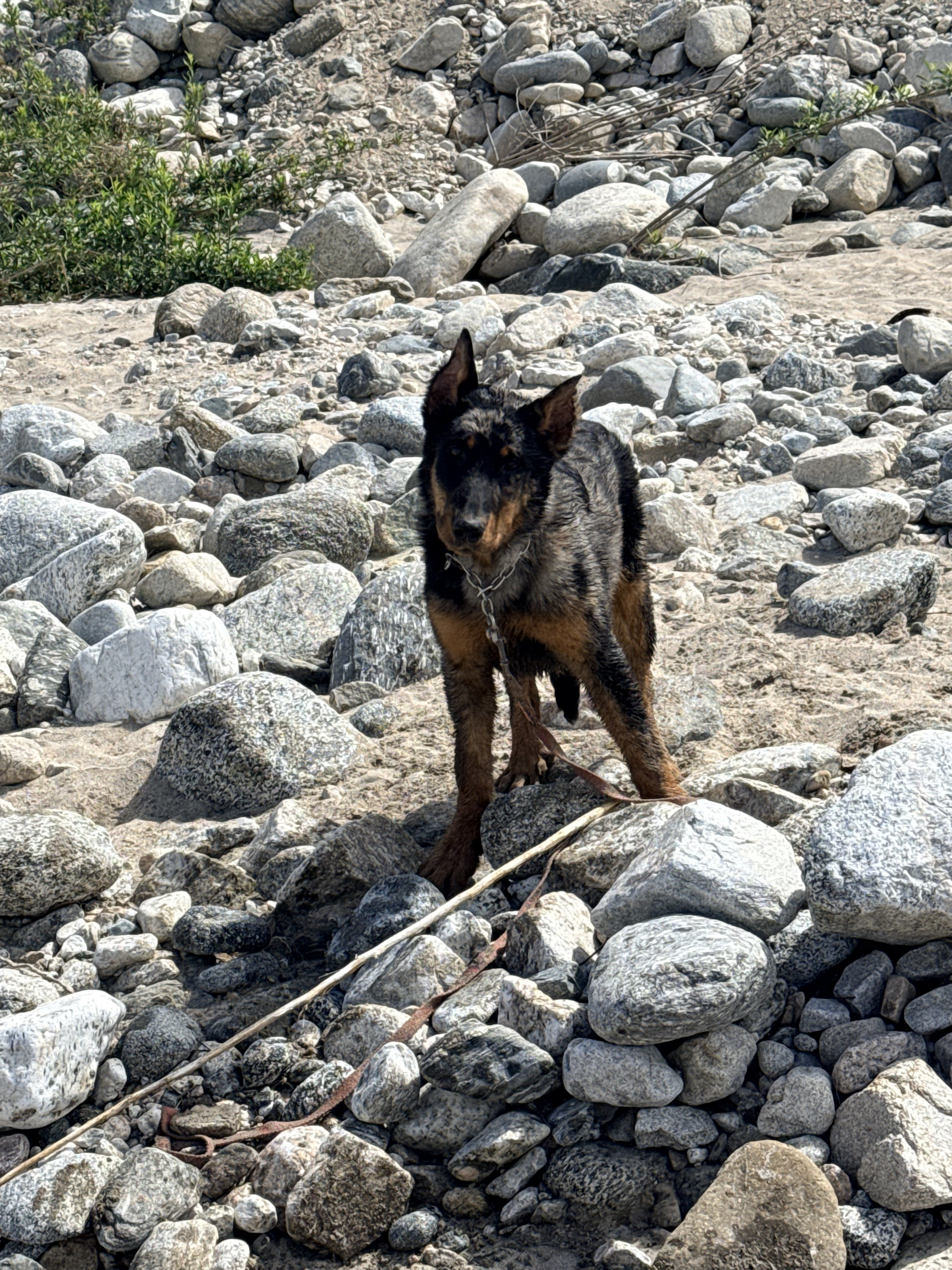
The Official Standard of the Beauceron
General Appearance: The Beauceron is an old and distinct French breed of herding dog,
developed solely in France with no foreign crosses. Dogs were bred and selected for their
aptitude to herd and guard large flocks of sheep as well as for their structure and endurance.
Beaucerons were used to move herds of 200 to 300 head traveling up to 50 miles per day without
showing signs of exhaustion. The ideal Beauceron is a well balanced, solid dog of good height
and well muscled without heaviness or coarseness. The whole conformation gives the impression
of depth and solidity without bulkiness, exhibiting the strength, endurance and agility required of
the herding dog. He is alert and energetic with a noble carriage. A formidable dog with a frank
and unwavering expression, he always demands respect wherever he goes. Dogs are
characteristically larger throughout with a larger frame and heavier bone than bitches. Bitches
are distinctly feminine, but without weakness in substance or structure. The Beauceron should be
discerning and confident. He is a dog with spirit and initiative, wise and fearless with no trace of
timidity. Intelligent, easily trained, faithful, gentle and obedient. The Beauceron possesses an
excellent memory and an ardent desire to please his master. He retains a high degree of his
inherited instinct to guard home and master. Although he can be reserved with strangers, he is
loving and loyal to those he knows. Some will display a certain independence. He should be
easily approached without showing signs of fear.
Size, Proportion, Substance: Size - males 25½ to 27½ inches; bitches 24 to 26½ inches at the
withers. Disqualification - Height outside of maximum or minimum limits. Proportion - The
Beauceron is medium in all its proportions, harmoniously built with none of its regions
exaggerated in shortness or length. The length of body, measured from the point of the shoulder
to the point of the buttock, is slightly greater than the height at the withers. Bitches can be
slightly longer than dogs. Correct proportion is of primary importance, as long as size is within
the standard's range. Substance - Powerful, well built, well muscled, without any sign of
heaviness or clumsiness. Dogs lacking substance should be severely penalized.
Head: The head is long, well chiseled with harmonious lines without weakness. The head must
be in proportion with the body, measured from the tip of the nose to the occiput it is about 40
percent of the height at the withers. The height and width of the head are each slightly less than
half its total length. The skull and muzzle are of equal length. Expression - The gaze is frank,
alert, and confident. Eyes - The eyes are horizontal and slightly oval in shape. The eyes must be
dark brown, never lighter than dark hazel. For the Harlequin, walleye is acceptable.
Disqualifications - Yellow eyes. Walleye in the Black and Tan. Ears - The ears are set high, and
may be cropped or natural. The cropped ear is carried upright and is neither convergent nor
divergent, pointing slightly forward. The well-carried ear is one whose middle falls on an
imaginary line in prolongation of the sides of the neck. The natural ears are half pricked or drop-
ears, they stand off the cheeks. Natural ears are flat and rather short, their length is equal to half
the length of the head. Disqualification - Natural ears carried upright and rigid. Skull - The skull
is flat or slightly rounded near the sides of the head. The median groove is only slightly marked
and the occipital protuberance can be seen on the summit of the skull. Stop - The stop is only
slightly pronounced and equidistant from the occiput and the tip of the nose. Muzzle - The
muzzle must not be narrow, pointed, or excessively broad in width. Planes - Seen in profile the
top lines of the skull and muzzle are parallel, and the junction of the two forms a slightly
pronounced stop midway between the occiput and the tip of the nose. Nose - The nose isPage 2 of 3
proportionate to the muzzle, well developed and always black. In profile, the nose must be in line
with the upper lip. Disqualifications - Split nose, nose color other than black or with
unpigmented areas. Lips - The lips are firm and always well pigmented. The upper lip overlaps
the lower lip without any looseness. At their juncture, the lips form very slight but firm flews.
Teeth - A full complement of strong white teeth, evenly set, and meeting in a scissors bite.
Disqualifications - Overshot or undershot with loss of contact; absence of three or more teeth
(the first premolars not counting).
Neck, Topline and Body: Neck - The neck is muscular, of good length, united harmoniously
with the shoulders, enabling the head to be carried proudly while standing in an alert posture.
Topline - The back is straight and strong. The withers are well defined. The loin is broad, short
and muscular. The croup is well muscled and slightly sloped in the direction of the attachment of
the tail. Body - The length of the body from the point of the shoulder to the point of the buttock
is slightly more than the height of the dog at the withers. Chest - The chest is wide, deep, long,
and descends to the point of the elbow. The girth of the chest is greater than the height at the
withers by more than 20 percent. Ribs - The ribcage extends well back with long, flexible, and
moderately curved ribs. The abdomen is moderately drawn up but still presents good volume.
Tail - The tail is strong at the base, carried down, descending at least to the point of the hock,
forming into a slight J without deviating to the right or to the left. In action, the tail can be
carried higher, becoming an extension of the topline. Disqualification - Docked tail, or tail
carried over the back.
Forequarters: The construction of the forequarters is of the utmost importance, determining the
dog's ability to work and his resistance to fatigue. The legs are vertical when viewed from the
front or in profile. Shoulder - The shoulders are moderately long, muscular but not loaded, with
good layback. Forearm - The forearms are muscular. Feet - The feet are large, round, and
compact with black nails. The pads are firm yet supple.
Hindquarters: The angulation of the hindquarters is balanced with the forequarters. The
hindquarters are powerful, providing flexible, almost tireless movement. They are vertical when
viewed from profile and from behind. Legs - The thighs are wide and muscled. Hock joint is
substantial, not too close to the ground, the point situated roughly at ¼ the height at the withers,
forming a well open angle with the second thigh. Metatarsals are upright, slightly further back
than the point of the buttock. When viewed from behind, metatarsals are perpendicular to the
ground and parallel to each other. Feet - The feet are large, round, compact, and the rear toes turn
out very slightly. Dewclaws - Double dewclaws form well separated "thumbs" with nails, placed
rather close to the foot. Disqualification - Anything less than double dewclaws on each rear leg.
Coat: Outer coat is 1¼ to 1½ inches, coarse, dense and lying close to the body. It is short and
smooth on the head, ears and lower legs. The hair is somewhat longer around the neck. The tail
and back of thighs are lightly fringed. The undercoat is short, fine, dense and downy, mouse gray
in color and does not show through the outer coat. The Beauceron is exhibited in the natural
condition with no trimming. Disqualification - Shaggy coat.
Colors: Black and Tan - The black is very pure; the tan markings are squirrel red; the markings
are: dots above the eyes; on the sides of the muzzle, fading off on the cheeks, never reaching the
underside of the ears; two spots on the chest are preferred to a breastplate; on the throat; under
the tail; on the legs the markings extend from the feet to the pasterns, progressively lessening,
though never covering more than one-third of the leg, rising slightly higher on the inside of thePage 3 of 3
leg. Some white hairs on the chest are tolerated. Gray, Black and Tan (Harlequin) - Black and
Tan base color with a pattern of blue-gray patches distributed evenly over the body and balanced
with the base color, sometimes with a predominance of black. Disqualifications - Any color other
than Black and Tan or Harlequin. Complete absence of markings. Well-defined, quite visible
white spot on the chest 1 inch in diameter or larger. In the Harlequin: too much gray; black on
one side of body and gray on the other; head entirely gray.
Gait: Movement is fluid and effortless, covering ground in long reaching strides (extended trot).
Strong, supple movement is essential to the sheepdog. In movement the head is lowered
approaching the level of the topline. Dogs with clumsy or inefficient gait must be penalized.
Temperament: Frank approach and self-assured; never mean, timid, or worried. Although
reserved with strangers, the character of the Beauceron should be gentle and fearless. Any
display of fear or unjustifiable aggression is not to be tolerated.
Faults: Any departure from the foregoing points should be considered a fault and the seriousness
with which the fault should be regarded should be in exact proportion to its degree.
Note: Males must have two normal testicles properly descended into the scrotum.
Disqualifications: Height outside of maximum or minimum limits. Split nose, nose color other
than black or with unpigmented areas. Overshot or undershot with loss of contact; absence of
three or more teeth (first premolars not counting).Yellow eyes. Walleye in the Black and Tan.
Natural ears carried upright and rigid. Docked tail, or tail carried over the back. Anything less
than double dewclaws on each rear leg. Shaggy coat. Any color other than Black and Tan or
Harlequin. Complete absence of markings.
Well-defined, quite visible white spot on the chest 1 inch in diameter or larger. In the Harlequin:
too much gray; black on one side of body and gray on the other; head entirely gray.


Comments