Beauceron FCI Standard
FEDERATION CYNOLOGIQUE INTERNATIONALE (AISBL)
SECRETARIAT GENERAL: 13, Place Albert 1er B – 6530 Thuin (Belgique)
______________________________________________________________________________
19.09.2023/ EN
FCI-Standard N° 44
BERGER DE BEAUCE
Beauce Sheep Dog (Beauceron, “Red-Stocking”)
TRANSLATION: John Miller, Raymond Triquet. Official language
(FR).
ORIGIN: France.
DATE OF PUBLICATION OF THE OFFICIAL VALID
STANDARD: 01.08.2023.
UTILIZATION: Sheepdog and Guard Dog.
FCI-CLASSIFICATION: Group 1 Sheepdogs and Cattle
Dogs (except Swiss
Cattle Dogs).
Section 1 Sheepdogs.
With working trial.
BRIEF HISTORICAL SUMMARY: “Beauce Dog”, “Beauceron”
and “Red-Stocking” were the names chosen at the end of the XIX
century to designate these ancient French Sheepdogs of the plains, all
of the same type, with smooth hair on the head, a harsh, short coat
and ears normally cropped. The body had tan markings, notably at
the extremities of the four legs, which led the breeders at that time to
call these dogs “Red-Stockings”. The coat was commonly black and
tan but there were also grey, entirely black and even wholly tan dogs.
These dogs were bred and selected for their aptitude to conduct and
guard flocks of sheep.
GENERAL APPEARANCE: The Beauce Sheepdog is big, solid,
hardy, powerful, well built and muscular, but without lumber.
IMORTANT PROPORTIONS: The Beauce Sheepdog is medium
in all its proportions. The length of the body from the point of the
shoulder to the point of the buttock should be slightly greater than
the height at the withers.
The head is long: 2/5 the height at the withers. The height and width
of the head are slightly less than half its total length. The skull and
muzzle are of equal length.
St-FCI n°44/ 19.09.20233
BEHAVIOUR / TEMPERAMENT: Frank approach and self-
assured. The expression is candid, never mean timid or worried.
The character of the Beauceron should be gentle and fearless.
HEAD: The head is well chiselled with harmonious lines. Seen in
profile, the toplines of skull and muzzle lie roughly in parallel
planes.
CRANIAL REGION:
Skull: Flat or slightly rounded from one side to the other. The
median groove is only slightly marked, the occipital protuberance
can be seen on the summit of the skull.
Stop: The stop is only slightly pronounced and is equidistant from
the occiput and the end of the muzzle.
FACIAL REGION:
Nose: Proportionate to the muzzle, well developed, never split and
always black.
Muzzle: Neither narrow or pointed.
Lips: Firm and always well pigmented. The upper lip should overlap
the lower without any looseness. At their commissure, the lips
should initiate a very slight pouch which should stay firm.
Jaws/Teeth: Strong teeth with a scissor bite.
EYES: Horizontal, slightly oval in shape. The iris should be dark
brown, and in any case never lighter than dark hazel even if the tan is
light coloured. For the harlequin variety, wall eyes are admitted.
EARS: Set high. Ears are half-pricked or drop-ears. They should
not be plastered against the cheeks. They are flat and rather short.
The length of the ear should be half the length of the head.
NECK: Muscular, of good length, united harmoniously with the
shoulders.
St-FCI n°44/ 19.09.20234
BODY
Topline: The back is straight. The loin is short, broad and well
muscled. The croup is only slightly inclined.
Withers: Quite visible.
Chest: The girth of the chest is greater than the height at the withers
by more than one fifth. The chest is well let down to the point of the
elbow. It is wide deep and long.
TAIL: Whole, carried low, it reaches at least to the hock, without
deviating, forming a slight hook in the form of a “J”. When in
action, the tail can be carried higher, an extension of the topline.
LIMBS
FOREQUARTERS: Upright when seen from the front or in profile.
Shoulder: Sloping and moderately long.
Forearm: Muscled.
Feet: Large, round, compact. The nails are always black. The pads
are hard but nevertheless resilient.
HINDQUARTERS: Upright when seen from profile and from
behind.
Thigh: Wide and muscled.
Hock joint: Substantial, not too close to the ground, the point situated
roughly at ¼ the height at the withers, forming a well open angle
with the second thigh.
Metatarsals (Rear Pasterns): Vertical, slightly further back than the
point of the buttock.
Dewclaws: By tradition, shepherds are much attached to the
conservation of double dewclaws. The dewclaws form well
separated “thumbs” with nails, placed rather close to the foot.
Feet: Large, round, compact.
GAIT / MOVEMENT: Supple and free. The limbs move well in
line. The Beauce Sheepdog should have an extended trot with long
reaching movement.
St-FCI n°44/ 19.09.20235
COAT
Hair: Smooth on the head, short, thick, firm and lying close to the
body, 3 to 4 cm in length. The buttocks and the underside of the tail
are lightly but obligatorily fringed. The undercoat is short, fine,
dense and downy, preferably mouse grey, very close, and can’t be
seen through the top coat.
Colour:
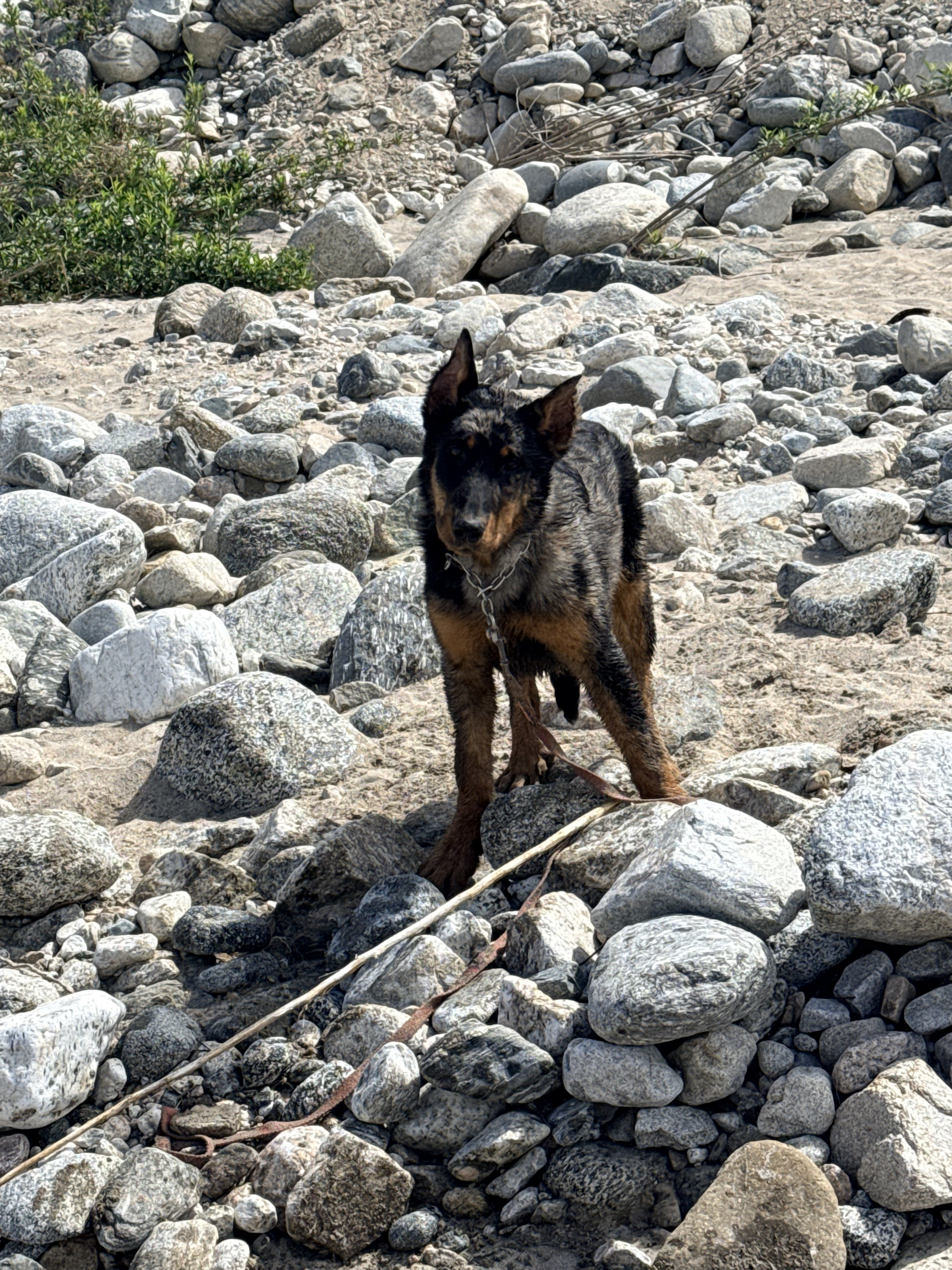
a) Black and tan (Black with tan markings): “red stockings”. The
black is pure black and the tan, red squirrel coloured. The tan
markings are distributed as follows:
• Spots over the eyes.
• On the sides of the muzzle, diminishing gradually on the
cheeks, never attaining under the ear.
• On the chest, preferably two spots.
• Under the neck.
• Under the tail.
• On the legs, disappearing progressively while rising,
without covering in any case more than 1/3 of the leg
and rising slightly higher on the inside.
b) Harlequin (blue-mottled with tan markings) : grey, black and tan,
the coat being black and grey in equal parts, the spots well
distributed, with sometimes a predominance of black. The tan
markings are the same as for the black and tan.
A faint while spot on the chest is tolerated.
SIZE:
Height at the withers: Male: Female: from 65 cm to 70 cm.
from 61 cm to 68 cm.
FAULTS: Any departure from the foregoing points should be
considered a fault and the seriousness with which the fault should be
regarded should be in exact proportion to its degree and its effect
upon the health and welfare of the dog.
St-FCI n°44/ 19.09.20236
DISQUALIFYING FAULTS:
• Aggressive or overly shy.
• Any dog clearly showing physical or behavioural.
• Size outside the standard limits.
• Too light-boned.
• Eyes too light, or wall eyes (except for harlequins).
• Split nose, of a colour other than black, with unpigmented
areas.
• Overshot or undershot with loss of contact, absence of 3 or
more teeth (the first premolars not counting).
• Natural ears carried totally upright and firm.
• Rear feet turned excessively to the exterior.
• Simple dewclaws or absence of dewclaws on hind legs.
• Shortened tail or tail carried over the back.
• Coat: Colour and texture other than those defined by the
standard. Complete absence of tan markings. Shaggy coat.
Well defined, quite visible white spot on chest. For the
harlequin variety: too much grey, black on one side and grey
on the other, head entirely grey (absence of black).
N.B.:
• Male animals should have two apparently normal testicles
fully descended into the scrotum.
• Only functionally and clinically healthy dogs, with breed
typical conformation, should be used for breeding.


Comments